
XIII Jornada e XI Colóquio - English
Índice de Artigos
XIII ETHNOMUSICOLOGY CONFERENCE
XI AMAZONIAN COLLOQUIUM ON ETHNOMUSICOLOGY
COLLECTIONS IN THE AMAZON: Challenges in Safeguarding
Amazonian Musical Heritage
Federal University of Pará – UFPA
Belém, Pará, Brazil
November 17 - 19, 2026
The Ethnomusicology Laboratory (LabEtno) at the Federal University of Pará - UFPA – which encompasses the Research Group on Music and Identity in the Amazon (GPMIA) and the Study Group on Music in Pará (GEMPA), both affiliated with UFPA – has as its primary objective to bring together and support research in the field of ethnomusicology. These activities are conducted within the Graduate Program in Arts (PPGARTES/UFPA), the Faculty of Music at UFPA, the UFPA School of Music (EMUFPA), and the UFPA School of Application (EAUFPA).
LabEtno's specific objectives include providing a structured body to support ethnomusicological research at UFPA; hosting and continuously enriching an existing archival collection; and fostering the production of knowledge about music in the Amazon region. Its main goals are to maintain an archive of sound and text records accessible to the community; to strengthen and expand the field of ethnomusicology in northern Brazil; to engage in research and outreach activities connected to local, regional, national, and international musical networks; to establish bridges between academia and traditional music masters and knowledge holders of the region; and to promote events, courses, workshops, and related activities in the field.
Among the events organized by LabEtno, the Ethnomusicology Conference (Jornada de Etnomusicologia) stands out, with twelve editions held to date, the last eight of which have been held jointly with the Amazonian Colloquium on Ethnomusicology organized by UEPA. The proposed event corresponds to the 13th edition of the Conference and the 11th edition of the Colloquium. Scheduled to take place over three days, it will feature, in particular, the participation of national and international researchers, professors, students, and musicians, among other groups, with activities structured around keynote addresses, lectures, research presentations, musical performances, discussions with Masters and Maestas of popular culture, and papers published in the Proceedings. The Conference and the Colloquium have been consolidating their position as important national events in the field of ethnomusicology in Brazil, despite having initially been conceived as regional events.
The Conference and the Colloquium represent a distinctive initiative in Northern Brazil, as they are simultaneously pioneering events at the regional level and events of significant recognition nationally and even internationally in the field of ethnomusicology. They seek to facilitate the sharing of research developed at undergraduate and graduate levels in music, while also promoting the dissemination of scientific production and academic texts in ethnomusicology and related fields in Portuguese, English, and Spanish. Furthermore, as a distinctive feature of methodological innovation, they adopt a perspective of decolonizing knowledge, insofar as they promote both dialogue between academia and cultural Masters and collaborative approaches to knowledge production and the ongoing reflection on the musical knowledge and practices under investigation. These knowledge holders have made significant contributions to research developed at LabEtno and within its associated Research Groups, including by teaching courses, giving lectures, and conducting workshops in partnership with professors from UFPA and UEPA.
The Amazonian Colloquium on Ethnomusicology, which originated at UEPA, subsequently began to take place jointly with the Ethnomusicology Conference, as LabEtno became an integrating body for the Research Groups of the two higher education institutions. Thus, the Colloquium became aligned with the profile and objectives of the Ethnomusicology Conference described above.
With regard to regional scientific production, the relevance of the Ethnomusicology Conference and the Amazonian Colloquium on Ethnomusicology as privileged means of disseminating, sharing, and documenting recent research should be emphasized. In addition to contributing to the consolidation of ethnomusicology in Pará and the Amazon, as well as other musical sciences with which it establishes interdisciplinary connections, these events bring to the forefront contemporary discussions of public interest, such as regional sustainability through significant cultural and musical expressions, the recognition and safeguarding of intangible cultural heritage, the construction of musical identities, the development of cultural tourism, and the appreciation of traditional knowledge and practices and those of minority groups, among other issues related to the development of the state of Pará and the Northern region, particularly in cultural, economic, and social terms.
The proposal for the 13th Ethnomusicology Conference and the 11th Amazonian Colloquium consists of a program featuring an Opening Keynote, three Round Tables, Oral Presentations selected by members of a Scientific Committee with at least national scope, two Artistic Presentations featuring Amazonian musical practices, and Book Launches.
The program will take place in person on the premises of the School of Music of UFPA. Organized by LabEtno and the Associated Groups of UFPA and UEPA, the 13th Ethnomusicology Conference and the 11th Amazonian Colloquium on Ethnomusicology will receive support from several internal and external partners of the two higher education institutions, including the Northern Network of Ethnomusicology Laboratories and two new Graduate Programs in Music approved by CAPES in 2023, both pioneering programs in the Northern region of Brazil: at UFPA, a Professional Master's Program in Music, and at UEPA, the Graduate Program in Music in the Amazon (PPGMUSA), an Academic Master's Program.
The guiding theme for the development of the 2026 edition proposed here seeks to engage in dialogue and reflection on the processes of establishing, curating, researching, and disseminating collections on Amazonian musics housed in Brazil and/or other countries. It also aims to reflect on the challenges, paradigms, and curatorial processes surrounding collections housed in the Amazonian region, such as the LABETNO collection and the Music in the Amazon Museum collection, while engaging with examples of community-based collections and collaborative curatorial processes. The relationships between the peoples represented in these collections and the institutions that hold and safeguard them will also be addressed, as will specific issues concerning the sound-musical ontologies that permeate these sound and music collections and their multiple forms of listening. The safeguarding of this musealized heritage is also one of the important issues to be discussed.
Guidelines for Paper Submission
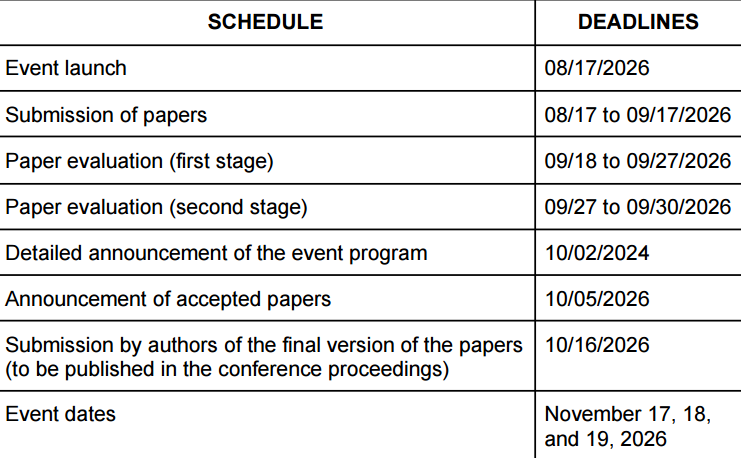
The papers approved by the Scientific Committee of the 13th Ethnomusicology Conference and the 11th Amazonian Colloquium on Ethnomusicology will be published in the Conference Proceedings and in the form of scientific articles. Submissions will be considered not only from the field of ethnomusicology, but from any field of knowledge, provided that music is necessarily addressed as an object of study. Thus, in addition to ethnomusicology, the event may accept submissions in music education, composition, performance practices, music theory, musicology, sonology, music therapy, and other musical subfields, as well as in anthropology (of art, dance, cultural, social, etc.), sociology, history, communication, geography, cultural studies, semiotics, aesthetics, medicine, biology, ecology, physics, and other non-musical fields whose submitted works must have music as their object of research and study.
Only original and unpublished texts will be accepted (texts that have not been presented or published at other events and are not currently undergoing publication) in Portuguese, Spanish, or English. The selection process will be conducted by a diverse Scientific Committee comprising members from different regions of Brazil and even from abroad. Each proposal will be submitted for evaluation by two reviewers and, in the event of divergent reviews, a third reviewer will make the final decision regarding its acceptance.
The evaluation criteria will be:
● Relevance of the paper (centrality of music, currency, innovation, and contribution to the field or fields of knowledge involved).
● Structure of the paper (clarity of objectives, fulfillment of the proposed objectives, clarity of exposition, consistency, and rigor of the argumentation).
● Quality of writing (compliance with academic standards, appropriate use of language, logical sequencing, and coherence in the development of ideas).
Papers will be received and forwarded to invited reviewers.
Submissions must be made exclusively through the event website, available at the link https://www.even3.com.br/xiii-jornada-de-etnomusicologia-e-xi-coloquio-amazonico-de-etnomusicologia-770020/ under the REALIZAR SUBMISSÃO (SUBMIT) section.
Paper templates are available at the following link: Templates for Articles in English/Spanish/Portuguese. The paper must be submitted in two versions:
Identified File (including the author’s name) in .doc, .docx, or .rtf format, and Anonymized File (without the author’s name, for peer review) in .pdf format.
All information regarding the event can be found on the website: www.labetno.ufpa.br.
Redes Sociais